A Brief Guide to PP Woven Bag Making Machines

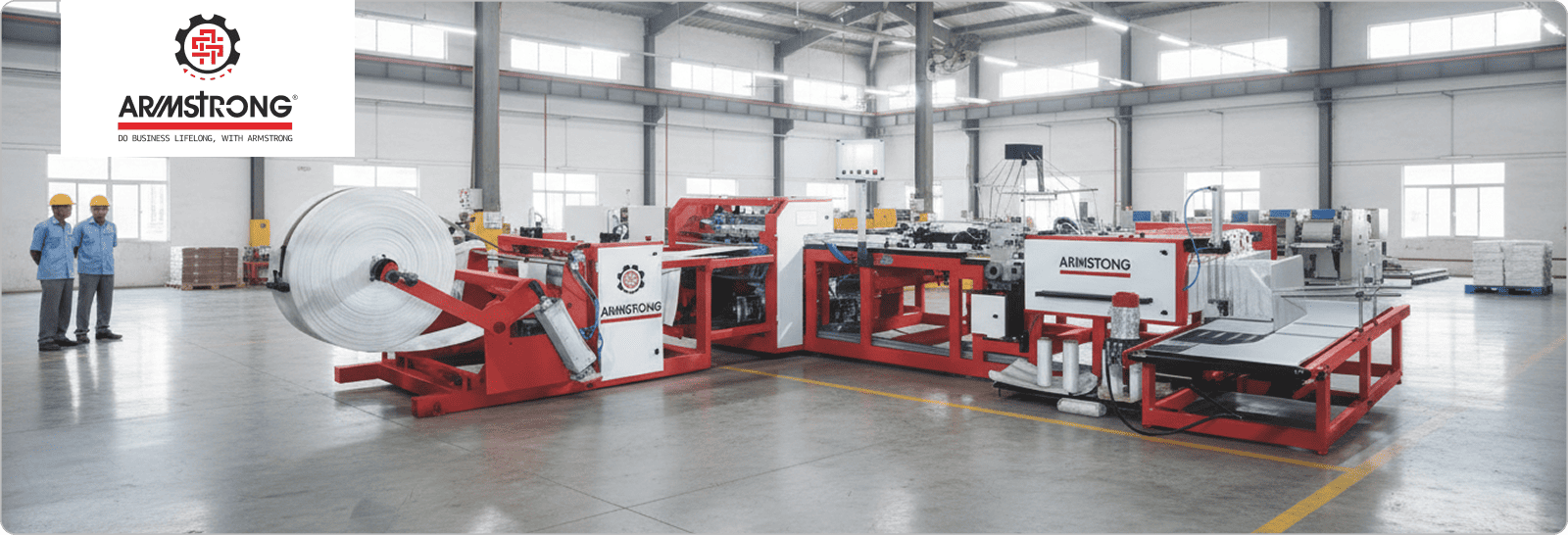
In the bulk packaging industry, efficiency is not just about speed, it is about consistency, accuracy, and reliability. From rice and fertilizer to cement and sand, woven bags are used across industries to store and transport products safely. There is a specialized production system known as the woven bag making machine behind every uniform, high-quality woven bag.
These machines convert circular or flat woven fabric into finished packaging bags. What once was a complex compulsory process is now handled by automated systems that have everything, cutting, sewing, liner pasting, punching, and handling in a single workflow. The post-processing stage is where raw woven fabric becomes a ready-to-use packaging product.
As manufacturers upgrade to higher automation and scalable production, PP Woven Bag Making Machines have become an important investment. They reduce labor dependency, improve bag consistency, and increase production output making them very important for modern packaging operations.
This guide explains what PP woven bag making machines are, how they work, their features, applications, and how to select the right system for your production.
A PP Woven Bag Manufacturing Machine is an industrial machine used to convert woven fabric into finished bags. Unlike basic cutting units, modern woven bag machines perform multiple post-processing operations continuously.
These operations typically include:
Advanced models work as a Fully Automatic PP Woven Bag Cutting & Sewing Machine, delivering consistent output with lesser manual dependancy.
These machines are widely used to manufacture:
From a production standpoint, this is where fabric rolls are transformed into sale-ready packaging products.
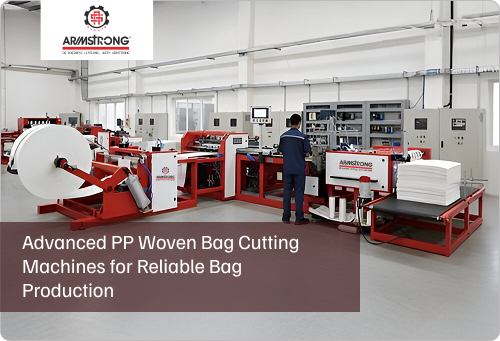
Also See: Advanced PP Woven Bag Cutting Machines for Reliable Bag Production
Not all woven bag machines are built the same. The right configuration depends on production volume, bag design complexity, and automation requirements.
Semi-automatic systems require some manual handling between operations such as cutting and stitching.
Best suited for:
These systems often rely on a standalone bcs machine for cutting and sewing functions.
Advantages include:
However, manual handling limits speed and consistency at higher volumes.
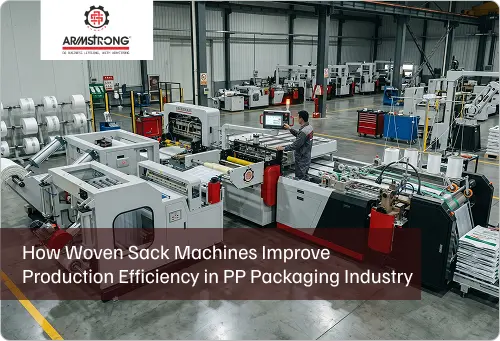
A High Speed PP Woven Bag Making Machine integrates cutting, folding, stitching, liner pasting, and stacking into one continuous workflow.
Key advantages:
These machines typically operate as a PP Woven Bag Cutting & Sewing Machine with conveyor integration, making them ideal for large-scale manufacturers.
The latest high-performance PP woven bag-making machines are built with accuracy, automation, and durability.
Core components include:
Key features include:
Machines like a woven bag cutting and sewing machine or pp woven bag cutting sewing machine deliver stable performance even under continuous industrial workloads.
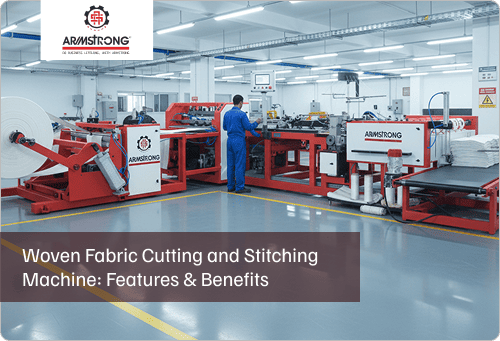
Read More: Woven Fabric Cutting and Stitching Machine: Features & Benefits
From an operational view, investing in a modern woven bag machine gives you smart business benefits.
Major advantages include:
Advanced systems such as a PP Woven Bag Cutting & Sewing Machine check that each bag meets dimensions accuracy and stitching consistency standards, important for downstream filling and stacking operations.
Woven bag making machines are widely used across industries that depend on bulk packaging.
Common applications include:
Machines such as a woven sack bag cutting machine or woven bag cutting and sewing machine are tailored to meet the specific packaging needs of each sector.
From a production workflow standpoint, these machines follow a continuous, automated process.
Typical process flow:
High-capacity models like a High Speed PP Woven Bag Making Machine can produce hundreds of bags per hour with stable accuracy and minimal variation.
This automation reduces post-processing bottlenecks that often slow down woven bag manufacturing.
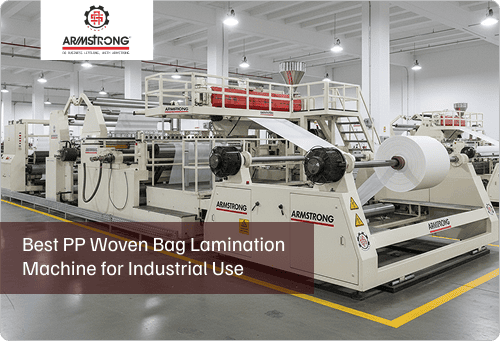
See Also: Best PP Woven Bag Lamination Machine for Industrial Use
From a buyer’s view, choosing the right machine is important for long-term productivity.
Key selection factors include:
Manufacturers check which machine, a BCS Machine for PP Woven Bag or a fully automated cutting-stitching line best suits production scale.
The wrong choice leads to inefficiency, downtime, and poor quality.
Regular maintenance is important for consistent output and long service life.
Best practices include:
Machines such as a pp woven bag cutting and sewing machine benefit from specialized maintenance.
A well-maintained system gives lesser downtime and improves operational reliability.
After understanding how woven bag machines work, the next step is studying the manufacturer.
Armstrong designs woven bag systems that combine tough durability with precise operation. Their machines can handle continuous production cycles with lower downtime.
Key strengths include:
As a Manufacturer of Premium PP Woven Bag Making Machines, Armstrong delivers machines that support consistency, quality and scalability.
In a competitive packaging industry, machine durability affects profitability.
Armstrong is a leading High Speed PP Woven Bag Making Machine supplier, focusing on engineering quality, service support, and production stability.
Their solutions range from semi-automatic systems to fully integrated Fully Automatic PP Woven Bag Cutting & Sewing Machine systems.
For manufacturers looking for a dependable PP Woven Bag Manufacturing Machine, Armstrong offers technology that matches with both current and future production.

Machines for producing PP woven bags are a large financial outlay for producers of bulk packages. Beginning with simple cut-off units, these machines enable the high-speed, repeatability, and ability to scale bag production through completely automated production lines.
Companies can make educated decisions regarding the purchase of PP woven bag manufacturing machines by understanding machine types, features, applications, and selection criteria for a successful long-term operation.
Choosing the right system, whether a woven bag making machine, a pp woven bag lamination machine, or a High Speed PP Woven Bag Making Machine, directly impacts productivity, quality, and profitability.
Explore more articles on innovation, engineering, and industry leadership.
December 7, 2024
September 8, 2025
October 15, 2025
November 25, 2025
November 26, 2025
December 29, 2025
February 23, 2026
February 24, 2026
August 10, 2026
August 20, 2026
August 26, 2026
 Previous