"In jumbo bag manufacturing, the real strength of a bag is tested long after it leaves the factory floor."
A bag may look perfectly stitched during inspection. The fabric may meet every GSM requirement. The dimensions may be accurate. But when that FIBC bag is lifted by a forklift carrying nearly a ton of material, everything depends on one thing — the loop stitching.
And that is exactly where many manufacturers still struggle.
Production managers in FIBC plants deal with this problem constantly. A bag fails during lifting because one loop takes more stress than the others. Stitching consistency changes between operators. Reinforcement patterns vary slightly during long production shifts. Some bags pass internal inspection but fail under actual loading conditions.
Loop stitching is not a small problem in the manufacturing process. A broken loop can cause issues with product quality, can lead to delays in loading, and create safety hazards in the workplace, for example, in the cement, chemical, fertilizer/molecular, and food grain industries.
These issues make loop stitching one of the most important quality assurance points during the manufacture of today's FIBCs.
And it is also why more manufacturers are moving away from manual stitching systems and investing in the automatic loop sewing machine.
Modern industrial production simply demands more consistency than manual operations can reliably maintain over long production cycles. The current-day consumers want greater load handling ability, evenly stitched seams, and consistent reinforced seams over every single bag being sent in a shipment. Manufacturers that cannot deliver those types of bags routinely experience high levels of rejection and therefore receive numerous customer concerns and increased costs related to production inefficiency.
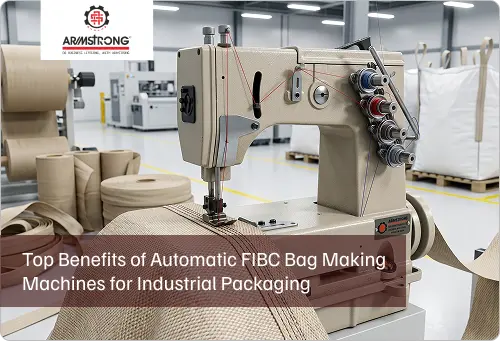
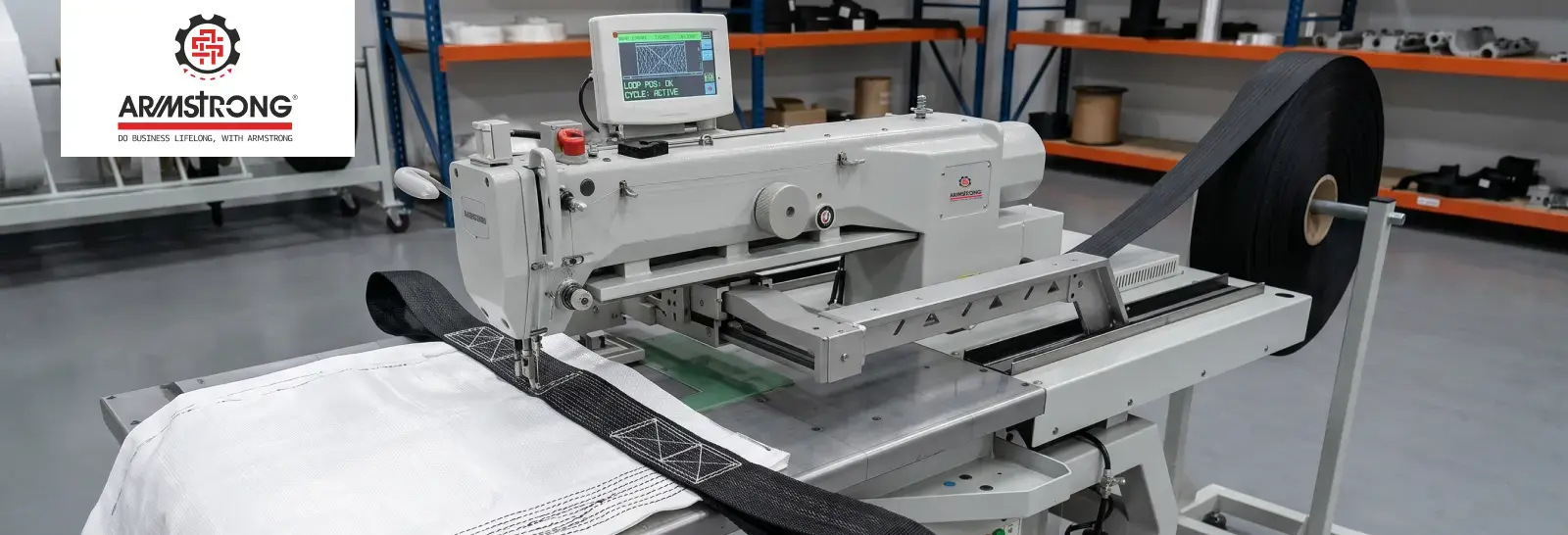
A jumbo bag loop sewing machine is an industrial sewing system designed to build lifting loops for FIBC bags. The lifting loops are used to carry the complete weight of the bag while it is being transported, stacked or lifted by a forklift. Therefore, the quality of the stitching plays a significant factor in the overall integrity and reliability of the bag.
An automatic jumbo bag loop sewing machine has been designed specifically for processing heavy sewing of polypropylene fabric and thick webbing materials continuously under industrial conditions, as well as being capable of performing reinforced stitching patterns with an even seam consistency and accurate positioning of the loop. Unlike traditional mechanical sewing machine designs, this new concept provides higher standards of workmanship than was previously possible.
In modern manufacturing plants, loop sewing systems are no longer treated as standalone stitching machines. They are integrated into the larger FIBC bag production machine workflow where synchronization between cutting, sewing, liner insertion, and finishing operations becomes important for maintaining production efficiency.
Advanced systems also use programmable controls, servo synchronization, and automated positioning systems to reduce operator dependency and improve repeatability across long production runs.
That repeatability matters more than most people realize.
Because in FIBC manufacturing, the biggest problem is rarely making one good bag. The real challenge is making thousands of bags with exactly the same lifting performance.
Many manufacturers entering the FIBC industry initially focus heavily on fabric quality. While fabric strength is important, experienced production teams know the actual lifting reliability of a jumbo bag depends heavily on the loop attachment area.
When a loaded FIBC bag is lifted, enormous pressure is transferred directly to the stitched reinforcement points connecting the loops to the bag body. If stitch density is inconsistent or reinforcement alignment shifts slightly, stress distribution becomes uneven. Over time, that increases the possibility of seam tearing or loop failure.
The dangerous part is that these weaknesses are not always visible during basic inspection.
A bag may appear perfectly acceptable while sitting empty in the warehouse. The failure often happens only during lifting operations when the bag is carrying its actual load weight.
That is why the importance of loop stitching in FIBC bags goes far beyond aesthetics or finishing quality.
In many factories, a large percentage of rejected jumbo bags are linked not to poor fabric, but to inconsistent stitching quality and reinforcement problems.
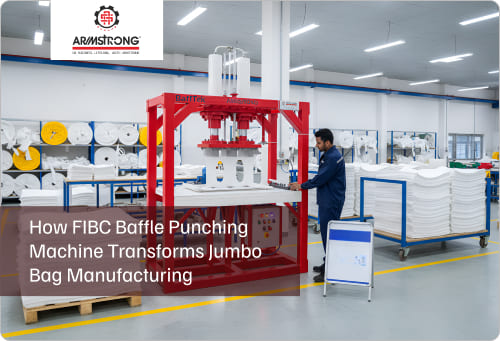
Learn more: How FIBC Baffle Punching Machine Transforms Jumbo Bag Manufacturing
Most manufacturers who have scaled FIBC production have seen the limitations of manual stitching firsthand.
At smaller production volumes, manual loop attachment may appear manageable. But as output requirements increase, consistency becomes difficult to maintain.
One operator may stitch tighter than another. Loop placement may vary slightly across batches. Reinforcement patterns may shift after long working hours. Even minor inconsistencies create problems because lifting stress in jumbo bags is never evenly distributed.
Operator fatigue also becomes a serious issue in manual production environments. Heavy woven fabric handling, repetitive stitching operations, and long production shifts eventually affect concentration and stitching precision.
Some of the most common issues manufacturers face in manual stitching setups include:
These are some of the biggest common problems in manual loop stitching that manufacturers struggle with as production demand increases.
When production quality depends too heavily on individual operator skill, scaling becomes difficult. One experienced operator leaving the production floor can directly affect output quality for an entire shift.
That lack of process stability is one of the strongest reasons industrial manufacturers are moving toward automation.
An advanced Automatic Pattern FIBC / Jumbo Bag Loop Sewing Machine creates a much more controlled stitching environment compared to manual systems.
Instead of relying entirely on operator judgment, the machine controls stitch formation, reinforcement patterns, alignment consistency, and sewing synchronization through programmed operations.
1. This improves production in several ways at once
First, loop placement becomes more accurate. Automated positioning systems maintain consistent reinforcement locations across every bag. Second, stitch density remains stable even during long production runs. Third, the machine maintains repeatability regardless of production volume.
2. That consistency is incredibly important in industrial packaging.
A manufacturer may produce thousands of jumbo bags for a single export order. If stitching quality changes midway through production, the entire shipment may fail inspection standards.
Modern Automatic Loop Sewing Machine systems also improve workflow movement across the production floor. Material handling becomes smoother, operators spend less time repositioning heavy fabric manually, and production output becomes easier to predict.
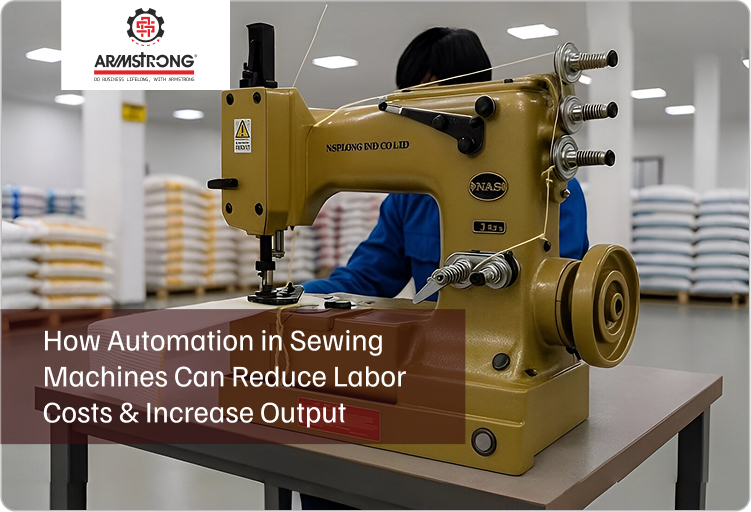
Automation provides manufacturers with stability in their operations, which allows them to increase their output and maintain high levels of quality assurance. Sewing machines are an excellent example of how automation can help manufacturers achieve this goal.
The first benefit most manufacturers notice after automation is production consistency.
Instead of relying on stitching variations between operators, the machine maintains standardized sewing quality throughout the shift. That directly reduces rejection rates caused by uneven reinforcement or weak loop attachment.
In many factories, production delays happen because bags require rework after inspection. Incorrect stitching patterns, alignment issues, or weak reinforcement areas slow down the entire workflow. Automated systems reduce those interruptions significantly.
A modern industrial sewing machine for jumbo bags also improves lifting reliability by maintaining stronger seam consistency during continuous production.
These advantages become especially valuable for export-oriented manufacturers where even small stitching defects can create shipment-level quality problems.
Not every jumbo bag uses the same loop configuration. Different industries and lifting methods require different designs depending on how the bags will be handled during transport and storage.
Cross-corner loops are commonly preferred because they improve forklift handling efficiency. Tunnel loops are often used in automated material handling environments where lifting consistency is critical.
Some loop configurations require heavier reinforcement patterns and stronger seam stability, especially in heavy-duty bulk bags designed for mining, cement, or chemical industries.
This is why manufacturers increasingly prefer automated systems capable of handling multiple loop configurations without sacrificing stitching precision.
Choosing the right loop sewing system involves much more than checking production speed.
Manufacturers should pay attention to how stable the machine performs during long production cycles. A machine may operate fast initially, but if vibration affects stitch quality over time, production consistency will eventually suffer.
An advanced Automatic jumbo bag loop sewing machine should also support multiple loop attachment styles and different woven webbing materials used across FIBC production.
Machine reliability matters just as much as machine speed.
Because in industrial manufacturing, downtime during active production schedules is often far more expensive than slightly slower output.
Even the best machine cannot maintain strong loop quality without proper production control.
Manufacturers focusing on improving stitch quality in FIBC bags usually pay close attention to several factors at the same time:
Thread selection is especially important. Poor-quality thread can weaken seam performance even if the stitching pattern itself is correct.
Regular inspection during production also makes a major difference. Experienced manufacturers do not wait until final inspection to identify stitching problems. They monitor reinforcement quality continuously during production to catch inconsistencies early.
Machine calibration plays an equally important role. Over time, needle wear, tension imbalance, or alignment shifts can slowly affect seam consistency if preventive maintenance is ignored.
Loop stitching may seem like one isolated operation, but in reality, it directly affects the efficiency of the entire production line.
In a modern jumbo bag manufacturing machine setup, loop sewing systems work alongside:
When loop stitching quality becomes inconsistent, the impact spreads across the workflow. More bags require inspection. Rework increases. Production slows down. Dispatch schedules get delayed.
That is why experienced manufacturers often prioritize loop stitching automation before upgrading other sections of the production line.
Because once lifting reliability becomes stable, overall production control improves significantly.
The demand for jumbo bags continues increasing because industries want stronger and more efficient bulk packaging solutions.
1. Cement Industry: Bulk cement handling requires durable FIBC bags sewing machine capable of carrying heavy loads safely during transport and stacking operations.
2. Agriculture Industry: Seeds, fertilizers, grains, and animal feed are commonly stored and transported using jumbo bags because they simplify bulk handling.
3. Chemical Industry: Chemical manufacturers require reliable bulk packaging systems capable of handling powdered compounds and industrial materials safely.
4. Food Processing Industry: Food-grade FIBC bags making machines are widely used for sugar, flour, starch, pulses, and grain transportation.
5. Mining & Mineral Industry: Mining operations depend heavily on strong industrial jumbo bags for transporting dense raw materials and mineral products.
Industrial sewing systems perform best when maintenance is handled consistently rather than reactively.
Routine lubrication, periodic needle inspection, cleaning of thread paths, calibration of tension, and review of alignment will all assist with maintaining uniformity in sewing consistently through long production runs.
Many manufacturers underestimate the speed at which tiny maintenance problems can impact the quality of seams being produced.
A needle that appears just slightly worn or the tension system that is not correctly set may not show any type of defect immediately; however, in tens of thousands of production cycles these very small differences will contribute to reduced loop strength and reliability of reinforcement.
Preventive maintenance will always be less costly than having unplanned delays in production while still being produced.

In modern FIBC manufacturing, loop stitching is no longer just another sewing operation. The quality and safety of a production process have become extremely vital to the overall success of that process.
Manufacturers who rely solely on stitching packages by hand are unable to keep their packages consistent and of good quality as industrial buyers continue to expect strong package performance in high volumes.
That is why the Automatic Loop Sewing Machine has become essential for serious FIBC manufacturers.
From improving seam consistency and lifting reliability to reducing rejection rates and stabilizing production efficiency, automation helps manufacturers build a far more controlled and scalable manufacturing environment.
And in an industry where one failed lift can damage products, delay shipments, or compromise workplace safety, that level of consistency matters more than ever.
Explore more articles on innovation, engineering, and industry leadership.
December 7, 2024
September 8, 2025
October 15, 2025
November 25, 2025
November 26, 2025
December 29, 2025
January 27, 2026
February 23, 2026
February 24, 2026
August 10, 2026
August 20, 2026
August 26, 2026
September 16, 2026
September 19, 2026
 Previous