Many manufacturers entering the narrow fabric and webbing industry assume that weaving is simply about running yarn through a machine and increasing production speed. But once production actually begins, the reality becomes very different.
Problems with uneven sides of tape, threads breaking, inconsistency of weaving density, machine vibrating at high speeds, and increased maintenance downtime can happen when manufacturers set up looms incorrectly. This is true for companies that produce webbings, bag straps, safety belts, lifting tapes, ribbons, or industrial narrow fabrics. Because even minor inconsistencies in these industries can greatly influence the quality of the finished product, it is important to understand how a Needle Loom Machine works, the loom configuration (set up), and production capabilities before you install or upgrade a weaving line.
Needle loom machines are used today in the textiles, packaging, automotive, luggage, and industrial webbing industries because they produce more stable, narrow fabric with better edge finishing and less yarn waste than other types of looms. Decorative ribbons, heavy-duty industrial webbings - the right loom directly affects production quality, operational expenses, and long-term dependable manufacturing of these types of items.
In this guide, we will cover how needle looms work, their applications, the capabilities for production, loom types, and how manufacturers can determine the best machine for their particular manufacturing needs.
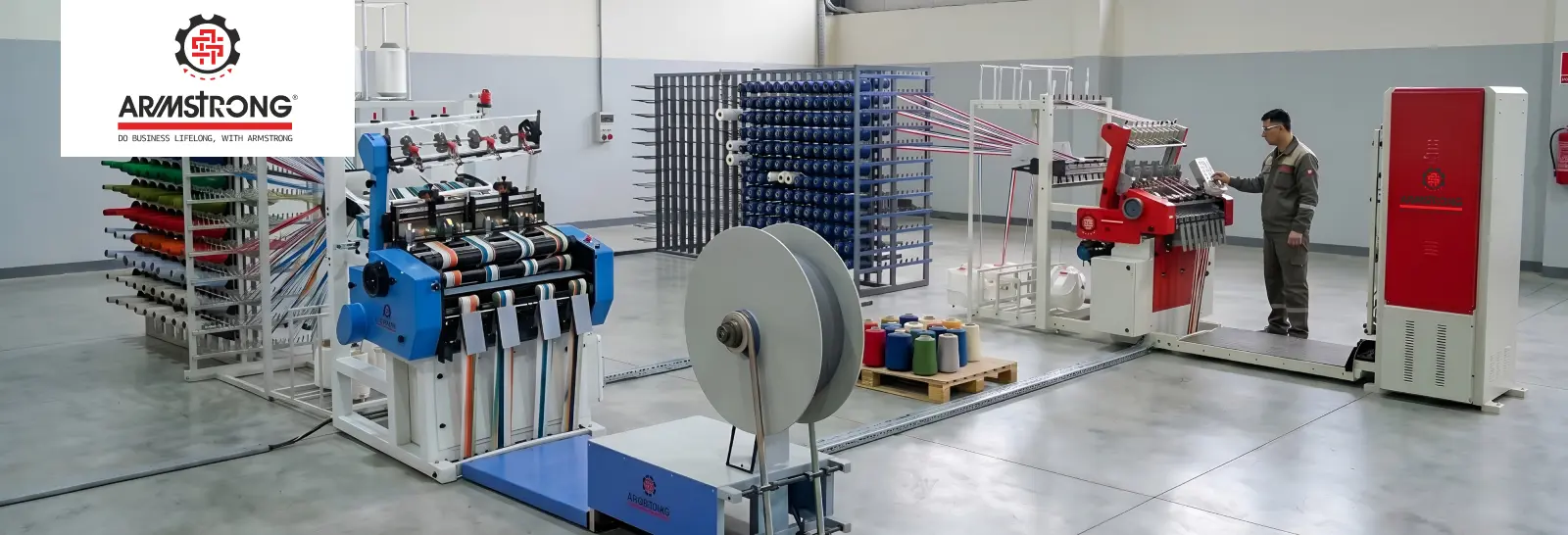
A Needle Loom Machine is a specialized weaving machine designed for manufacturing narrow woven fabrics such as webbings, tapes, ribbons, elastic straps, safety belts, bag handles, and industrial narrow fabrics.
Unlike conventional fabric weaving machines that produce wider fabric rolls, needle looms are specifically engineered for narrow-width weaving applications where precision, edge stability, and tension control are critical.
The machine uses needle-based weft insertion technology to interlace warp and weft yarns continuously at high operating speeds. Because of this weaving method, manufacturers achieve:
Modern High-Speed-Needle-loom Machine systems are now heavily used in industrial manufacturing because they improve both productivity and fabric consistency during long production cycles.
As time passes, loom technology has changed a great deal. In earlier versions of these machines, there was much dependence upon manual adjustments and mechanical synchronization; however, today's High-Quality Automatic Needle Loom Machines utilize modern technology, including advanced automation systems, servo synchronization, digital controls, and electronic monitoring. All of these features help decrease the number of broken threads and create consistent quality in woven fabrics.
For manufacturers producing export-quality webbings or industrial straps, this level of consistency becomes extremely important.
Different industries require different types of narrow fabrics, which is why needle loom machines are available in multiple configurations depending on production requirements.
Some systems are designed for lightweight ribbons and garment tapes, while others are built specifically for heavy industrial webbings capable of handling high tensile loads continuously.
At Armstrong, manufacturers can find multiple advanced weaving solutions designed for different applications, including:
Standard machinery is very commonly utilized for producing lightweight tapes, ribbons, garment accessories, elastic narrow fabrics, and decorative webbings that will be used in the textile/apparel industry, including woven products.
These systems are designed specifically around producing smooth weaving quality, consistent tape formations, and increased production rates.
The Heavy Duty Needle Loom Series has been created to manufacture durable industrial webbing products like the following: luggage straps, cargo belts, safety harnesses, industrial lifting tapes, and other heavy-duty packaging applications.
The construction of these machines includes reinforced construction, a more robust tension system, and a more stable weaving mechanism suitable for the continuous production of high-density yarns.
Modern manufacturers increasingly prefer Needle Loom Machine with HMI systems because they simplify machine control and production monitoring.
Instead of relying entirely on manual settings, operators can manage:
through user-friendly touchscreen controls. This improves operational accuracy while reducing setup time.
A Weaving Ribbon Loom Machine is widely used for decorative ribbons, garment tapes, and lightweight woven accessories requiring fine weaving precision and cleaner finishing quality.
This specialized machine is designed for manufacturing strong industrial webbings used in FIBC lifting belts, cargo straps, and heavy-duty industrial applications where high tensile strength is critical.
Advanced braiding systems produce a variety of specialty woven products that require the following characteristics of manufacturing: malleable braids, smooth fabric, and a consistent production efficiency throughout each manufacturing cycle of a continuous weave.
At first glance, a needle loom machine may appear mechanically simple. But internally, it performs highly synchronized weaving operations at extremely high speeds.
The process begins with warp yarn preparation. Yarns that have been warped together are fed through the loom by means of a set of tension-controlled feeding devices so that the warp yarns will move smoothly while being woven. Maintaining balanced tension on each of the warp yarns is essential, as the smallest variation of tension could cause fabric density and edge irregularities.
After the warp yarns enter the weaving area of the machine, the weft yarns are continuously inserted into the warp shed via a needle-type mechanism rather than using a shuttle loom. As a result, needle looms are capable of producing at an increased rate with reduced amounts of yarn waste than shuttles.
When filing into place, beat-up mechanisms help to compress the woven structure to maintain the correct density of the tape as well as to ensure consistent weaving has been performed. Once the small-width fabric is fully woven, it is transferred through a pulling and winding mechanism so that it can be collected in a continuous manner.
Modern automatic needle loom machine benefits include:
This controlled weaving process is one of the main reasons needle looms are preferred for industrial webbing applications where dimensional consistency and tensile strength are extremely important.
One reason the industrial needle loom machine market continues growing rapidly is that narrow woven fabrics are used across an enormous range of industries.
Different sectors use needle loom machines for completely different applications, depending on the type of webbing or tape required.
The packaging industry uses woven webbings for:
Automotive manufacturers use needle loom systems for safety belts, seat webbings, restraint systems, and fastening applications.
This is where the needle loom machine for safety belt production becomes extremely important because automotive webbings require high tensile strength and highly consistent weaving quality.
Garment tapes, ribbons, decorative webbings, elastic bands, and woven trims are commonly produced using needle loom machines.
Luggage manufacturers use narrow woven webbings for shoulder straps, reinforcement belts, fastening tapes, and carrying handles.
Heavy industrial straps used in cargo handling, lifting systems, safety harnesses, and industrial securing solutions are produced using a needle loom machine for heavy-duty webbing applications.
Machine specifications vary significantly depending on the type of fabric being manufactured.
Manufacturers generally evaluate:
A modern Heavy narrow webbing machine designed for industrial lifting straps operates very differently from a lightweight ribbon weaving system.
Some advanced systems now operate at extremely high RPM while maintaining stable weaving quality and lower vibration levels. Machines equipped with electronic synchronization and digital monitoring also provide more stable production performance during long manufacturing cycles.
Production capacity depends on much more than machine speed alone.
Factors affecting output include:
The current high-speed needle loom machine will be beneficial to the manufacturer due to the long operational hours of production, while also minimizing the occurrence of weaving defects due to vibration or an inconsistent yarn feed. However, when it comes to actual production, the stability of the machine and the quality of maintenance will have much more of an overall effect on production than just high theoretical speed specifications.
Many manufacturers look only at RPM when deciding which machine to purchase, then find themselves facing more downtime, more thread breaks, and more inconsistency in the fabric they are manufacturing after they purchase the machine.
One of the biggest advantages of needle loom technology is weaving precision.
Since these machines are designed specifically for narrow-width fabric production, manufacturers achieve much better control over tape structure and edge finishing compared to wider weaving systems.
Some major advantages include:
Modern High-Quality Automatic Needle Loom Machines also reduce manual intervention through synchronized controls and automated monitoring systems.
If your business manufactures webbings of export quality, then consistency in production will directly increase customer confidence and lower rejection rates.
Choosing the right loom depends entirely on the type of narrow fabric being produced.
A manufacturer producing lightweight decorative ribbons does not require the same machine configuration as a company manufacturing industrial lifting straps or safety webbings.
Before investing, manufacturers should evaluate:
An experienced needle loom machine supplier usually helps businesses select machinery based on actual production requirements rather than simply recommending the highest-speed system available.
If you want to buy a needle loom machine online, make sure to check the availability of replacement parts and the level of long-term technical support that will be provided, as these are very important factors to consider before making a decision.
Like any industrial weaving equipment, needle loom systems require regular maintenance to maintain stable production quality.
Basic needle loom machine maintenance tips include:
Many weaving defects actually begin because of neglected maintenance rather than direct machine failure.
Small problems such as worn-out needles or uneven yarn tension can accumulate over an extended period and ultimately result in inconsistent weaving.
Manufacturers utilize preventative maintenance methods to avoid costly downtime and improve product quality in the long term by ensuring machines are maintained for safe, reliable operation.
Energy efficiency has become increasingly important because most weaving units operate continuously for long production shifts.
Modern industrial needle loom machine systems now use energy-efficient motors, optimized motion control systems, and synchronized drive mechanisms to reduce unnecessary power consumption.
Machines that have a stable motion control system can reduce mechanical stress and vibration. This also increases the energy efficiency of a machine and increases the machine's life span over time.
For high-volume weaving operations, less power consumption will allow for significant savings in operating costs over time.
The cost of a needle loom machine depends on several factors, including:
A lightweight ribbon weaving machine will naturally cost less than a fully automated Heavy Duty Needle Loom Series designed for industrial webbing production.
Manufacturers need to assess the total production value throughout the lifespan of the particular machine, rather than just assessing the initial purchase price.
A less expensive machine that operates poorly, is unreliable, and has higher than normal maintenance costs can ultimately be more costly than an initial higher priced machine.
Armstrong designs advanced needle loom systems focused on weaving precision, production stability, and long-term industrial reliability. Our machines are engineered for manufacturers producing narrow woven fabrics across textile, packaging, automotive, luggage, and industrial webbing industries.
From lightweight decorative ribbons to heavy-duty industrial webbings, Armstrong machines deliver:
As a trusted Needle Loom Machines Manufacturer, Armstrong offers advanced weaving solutions, including Needle Loom Machine with HMI, Weaving Ribbon Loom Machine, Webbing and Tape Making Machine, and specialized heavy lifting belt weaving systems designed for modern narrow fabric manufacturing industries.

The narrow fabric industry is advanced beyond its historical origins as a weaving industry with vast potential for future growth. In order to be competitive, manufacturers expect their manufacturing suppliers to provide the following: higher production efficiency, stable weaving quality with lower downtime, and greater control over the manufacturing process.
Selecting a proper Needle Loom Machine is one of the most critical decisions any manufacturer will make when designing a manufacturing facility.
Not only does an appropriately designed needle loom machine increase the weavings, but it will also allow a manufacturer to reduce yarn waste and increase the stability of their production output to increase the operational efficiency of their business while promoting continued long-term growth.
For businesses planning to enter or expand narrow fabric manufacturing, understanding how needle loom machines work and choosing the right configuration for the application can make a major difference in both production quality and long-term profitability.
Explore more articles on innovation, engineering, and industry leadership.
December 7, 2024
September 8, 2025
October 15, 2025
November 25, 2025
November 26, 2025
December 29, 2025
January 27, 2026
February 23, 2026
February 24, 2026
August 10, 2026
August 20, 2026
August 26, 2026
September 16, 2026
September 19, 2026
 Previous