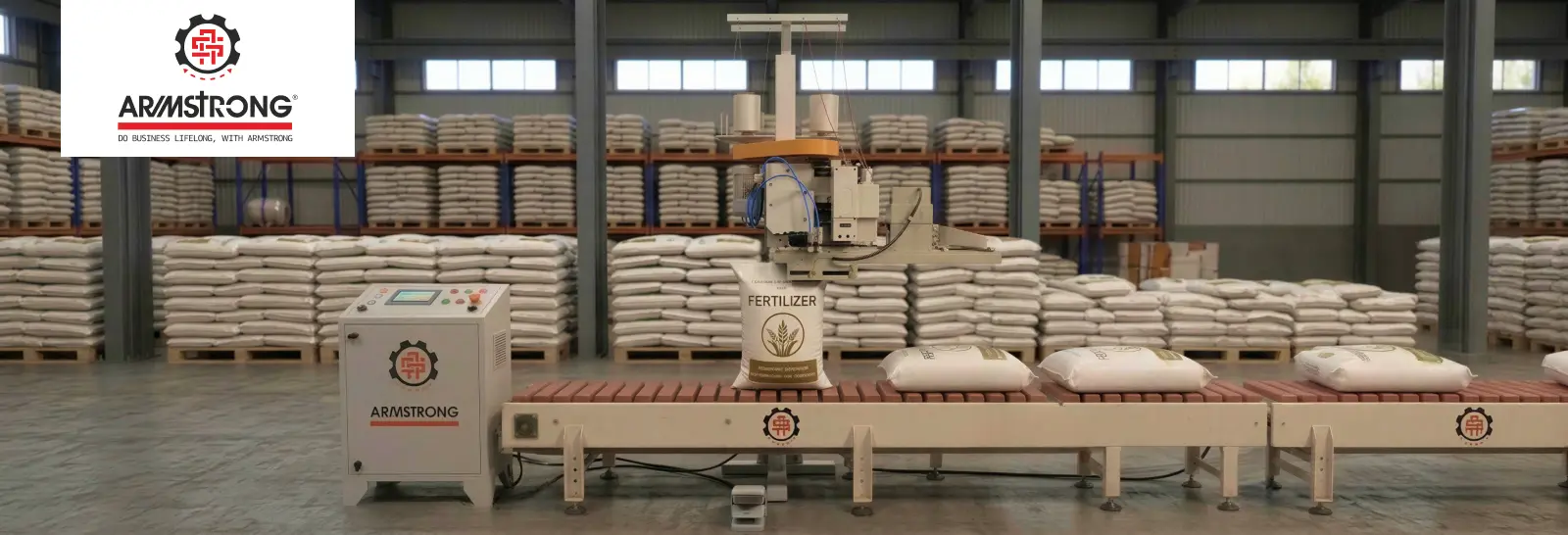
When filled bags are meant to be lifted, piled, shipped, and manipulated extensively during repeated use, the closure needs proper attention, not a second thought. A heavy-duty stitching machine is built to meet this scenario, balancing sturdy construction with accurate stitching, and is ideal for heavy-duty packaging.
Traditional garment-sewing machinery isn't intended for this kind of application, as industrial bag-closing machines are generally designed for denser fabrics, filled sacks, round-the-clock operation, and reliable seam-setting.
In industrial packaging, a strong bag is only as reliable as the closure holding it together.
The correct equipment selection and stitch technology are crucial to ensure that manufacturers of PP woven bags, paper bags, jute bags, cotton bags, laminated bags, or multi-layer bags experience good performance and longevity. The stitching machines can make a significant difference in the overall performance, in terms of stitch strength, speed and rate of production, operator effort, and maintenance.
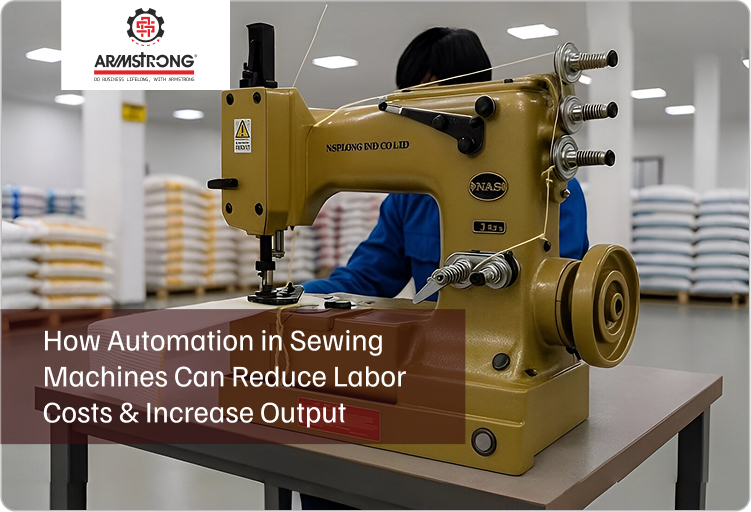
The heavy duty stitching machine is an industrial sewing machine for the application to stitch and to close bags from tough or heavy duty packaging materials.
An industrial bag stitching machine typically employs a needle and thread stitching process to make a running stitch down the mouth of a bag. Depending on your industrial packaging needs, there are models designed with single or double-needle configurations and various thread arrangements.
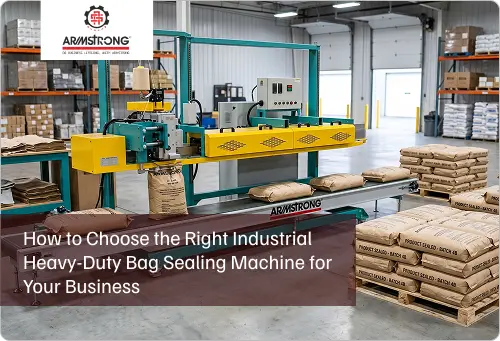
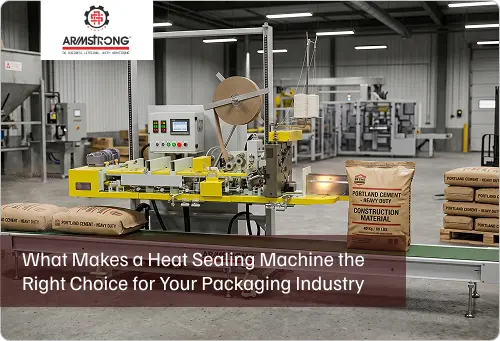
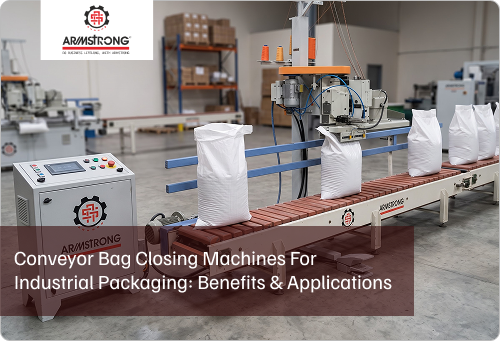
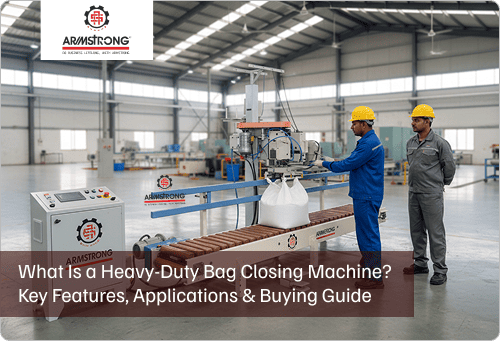
The Armstrong AS800 BC-ATC Heavy-Duty Bag Closer Stitching Machine is available in single/double-needle and 2/4-thread configurations. It comes equipped with a creape-tape cutting mechanism and automatic threader, an in-feed device, a control panel, a movable pedestal, and a wooden-slat conveyor.
Industrial bags are used to pack items like grains, flour, sugar, fertilizers, animal feeds, chemicals, and building products. Once filled, bags may be picked up, conveyed, piled, loaded, and shipped multiple times.
Closure will have to withstand actual handling experiences. A heavy duty bag stitching machine will allow manufacturers to create reproducible closures without solely relying on hand-sewing alone. This is even more critical with greater production outputs because poor seams could lead to spilled product, waste, or rejected packages.
The right equipment should provide:
Different production environments require different machine arrangements.
Portable machines are useful when operators need to close bags at different filling points or workstations. They can be practical where fixed conveyor integration is unnecessary.
A fixed machine is installed at a dedicated closing station. This arrangement provides stability and suits repetitive production where filled bags arrive at a defined location.
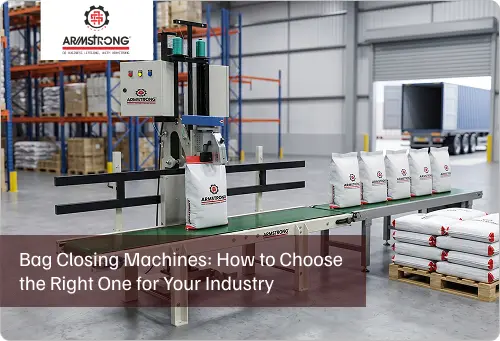
For higher-volume operations, the stitching head can work with a conveyor that supports and moves filled bags through the sewing area. This reduces manual movement and helps maintain consistent positioning.
An automatic bag stitching machine can incorporate automated feeding, threading, cutting, and bag movement depending on its configuration. Such systems are particularly useful when the stitching station forms part of a continuous packaging line.
Understanding the main components helps buyers evaluate a machine beyond its advertised speed.
The stitching head contains the needle, looper, thread-handling mechanism, and other working components responsible for creating the seam.
Needle and thread selection must correspond to the bag material and required seam strength. A configuration suitable for paper packaging may not be appropriate for thick woven PP.
The in-feed mechanism guides the bag toward the stitching head and helps maintain its position. Armstrong's AS 800 BC-ATC includes an advanced bag in-feed device.
A conveyor supports and transports filled bags through the stitching area. Armstrong's heavy-duty model incorporates a wooden slat conveyor.
Automatic cutting reduces manual finishing after stitching. Armstrong's AS 800 BC-ATC includes automatic threading and crepe-tape cutting.
The control panel allows operators to manage the machine and maintain a consistent stitching process.
The stitching process is straightforward, but coordination between the bag, needle, thread, and feeding system determines the final seam.
The filled bag is brought to the stitching station, with its open mouth aligned with the stitching head.
The in-feed mechanism or conveyor moves the bag at a controlled rate. Stable movement helps maintain a uniform stitch.
The needle passes through the bag material while the thread mechanism forms the required chain stitch. The exact configuration depends on the machine and application.
As the bag moves forward, stitching continues along the opening. Consistent feeding and thread tension are important for seam quality.
Once stitching is complete, the thread is cut. Automatic cutting features can reduce manual finishing work.
The finished bag can then move to inspection, stacking, storage, or dispatch.
Heavy duty industrial stitching machines are used wherever filled bags require strong and dependable mechanical closures.
Typical applications include:
Armstrong offers automatic stitching machine for bags suitable for the following sectors: Agriculture, Food & beverage processing, Animal feed & poultry, Fertilizer & agrochemicals, Packaging & logistics, Construction & building materials.
A bag stitching machine shouldn't be selected simply because it is marketed as heavy-duty. The useful question is whether its features match the production requirements.
Single- and double-needle configurations provide flexibility for different closure requirements. Armstrong's AS 800 BC-ATC supports both configurations.
Different bag structures may require different thread arrangements, so configuration flexibility can be useful when a manufacturer handles multiple bag types.
Automatic threading can simplify operation and reduce setup-related manual work, particularly during repetitive production.
Where tape is part of the closure, automatic cutting can reduce manual trimming and finishing.
Even a robust stitching head cannot compensate for poor bag positioning. A stable in-feed system helps maintain consistent movement through the stitching area.
Continuous production places repeated loads on the machine. Components therefore need to be designed for sustained industrial use.
Simple controls make operation easier and help operators monitor the stitching process during longer production runs.
Properly selected heavy duty industrial sewing machines can improve several areas of industrial bag production.
Heavy-duty stitching systems are designed for applications where seam strength is important.
Mechanical stitching provides greater repeatability than manually closing every bag, particularly during long production runs.
An automatic bag stitching machine can reduce repetitive operator tasks and support a more continuous workflow.
Depending on its configuration, a sewing machine for heavy duty applications can be suitable for PP/PE woven, paper, jute, cotton, laminated, and multi-layer packaging.
Automatic threading, tape cutting, and in-feed systems can reduce the amount of repetitive finishing work required.
“The fastest stitching machine isn't always the most productive one. The better machine is the one that keeps the line moving consistently.”
For the bag manufacturer, the goal should not be to automate just because you can automate. Smart automation is achieved when we automate where the automation provides a clear advantage, such as helping to achieve consistent stitches, eliminating rote jobs, and unnecessary physical movement of the product or personnel.
Machine speed is only one part of productivity. The entire stitching station needs to work smoothly with the sewing machines.
Start by matching the needle and thread to the bag material. An unsuitable combination can increase thread breaks, skipped stitches, and downtime.
Next, ensure bags reach the stitching head consistently. Poor alignment can produce uneven seams even when the machine itself is functioning correctly.
Operators should also monitor stitching quality throughout production rather than checking only the first few bags. Changes in thread tension, needle condition, or material feeding can gradually affect the finished seam.
For high-volume facilities, integrating the stitching head with a conveyor can further reduce manual bag movement and create a more organized production flow.
Even robust heavy duty sewing machines require routine maintenance.
Operators should also watch for changes in machine noise, vibration, thread breakage, or seam quality, as these can indicate that maintenance is required.
Before investing in a heavy duty commercial sewing machine, evaluate the actual production requirement rather than focusing only on maximum speed.
Bag material: PP woven, paper, jute, cotton, laminated, and multi-layer bags can have different stitching requirements.
Production volume: Portable equipment may suit moderate production, while fixed or conveyor-integrated systems can be better suited to continuous operations.
Stitch configuration: Determine whether single or double-needle and two- or four-thread stitching is appropriate.
Automation: Consider automatic threading, tape cutting, bag feeding, and conveyor integration where these features can genuinely improve workflow.
Service support: Spare parts, technical assistance, operator training, and servicing support are important for equipment expected to operate continuously.
Selection of an industrial heavy-duty sewing machine is a long-term manufacturing decision. Besides the initial specification, the machine configurations and the support from the manufacturer’s engineering know-how also play an important part. Armstrong’s AS 800 BC-ATC Heavy-Duty Bag Closer Stitching Machine series can fulfill the high-speed bagging requirements for industrial purposes.
The machine system has configurable single/double needle options with 2/4 thread stitches and is well-equipped with an automated threader, crepe tape cutter, a bag in-feed, a height-adjustable pedestal, a digital control panel, and a wooden slat conveyor.
In addition to this series, there is a range of other bag closing systems from Armstrong’s product portfolio, including Newlong Bag Closing Machine, Portable Bag Closer Machine, Bag Sealing Machine, and Vertical Heat Sealing Machine, so that manufacturers can achieve a bagging solution according to their real needs (based on materials, work efficiency, and operating needs).

The importance of a proper heavy duty stitching machine for industrial bag manufacturers cannot be underestimated, especially in terms of seam strength, consistency, and operating efficiency. A properly designed system may relieve operators of much of the mundane labor, provide more consistent seams, and keep packaging lines running.
Before choosing any one machine, however, the application should dictate the choice. Factors such as the material the bag is composed of, the needle and thread used, packaging rate, in-feeding capabilities, automation, ease of maintenance, and technical service are all major considerations for whether a machine is actually appropriate.
For manufacturers of industrial bags that do heavy duty packaging, Armstrong's suite of bag-closing systems has alternative configurations designed to meet varying production levels. In tailoring equipment to actual application-not top claimed speed, a more reliable, efficient bag-closing operation is the result.
Explore more articles on innovation, engineering, and industry leadership.
December 7, 2024
September 8, 2025
October 15, 2025
November 25, 2025
November 26, 2025
December 29, 2025
January 27, 2026
February 23, 2026
February 24, 2026
August 20, 2026
August 26, 2026
September 16, 2026
September 19, 2026
 Previous