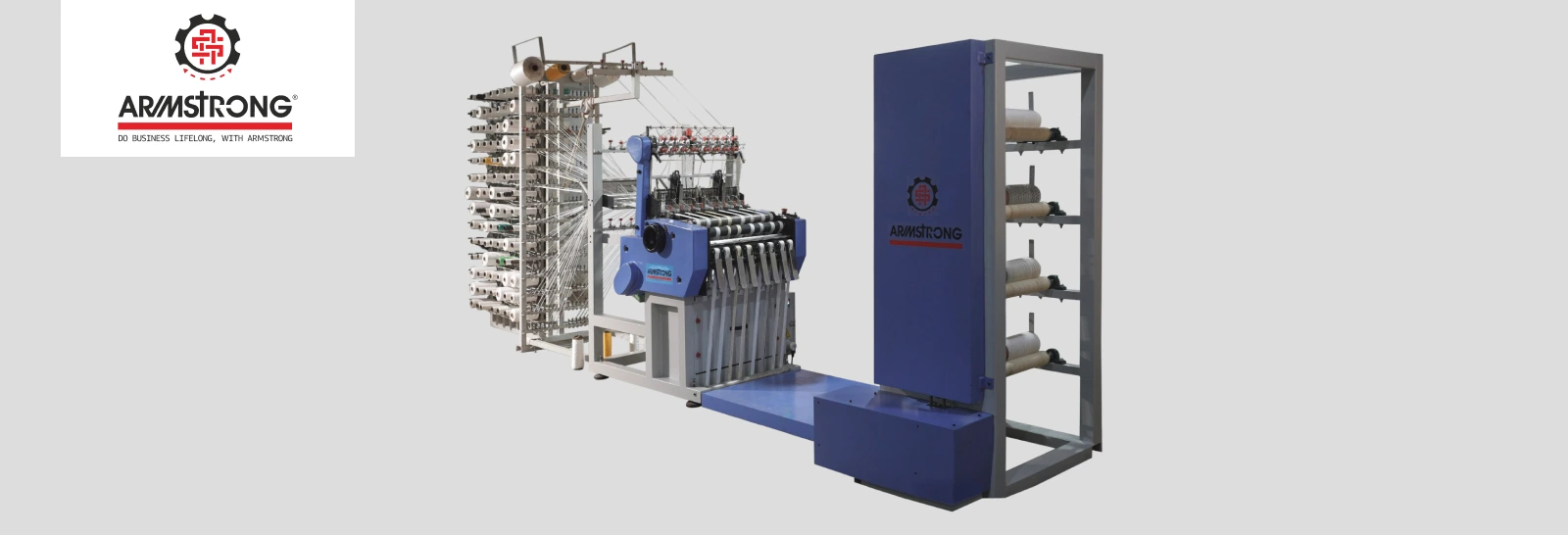
Put simply, a circular loom machine turns flat PP or HDPE tapes into a tube of woven fabric. The warp tapes come up from a creel. Shuttles, each carrying a bobbin of weft, run round a ring and weave across them, again and again. It’s the same basic idea as a hand loom, just wrapped into a circle and driven by motors.
Because the fabric comes out as a tube, the woven body doesn’t need a side seam. Cut a length, stitch one end, and you have a sack ready for filling. Skipping that extra seam saves a whole conversion step, which is a big reason this machine took over woven packaging.
So what makes a loom “high-speed”? Mostly the build. Better balancing, lighter shuttles, and tougher cams let it run faster for a whole shift without shaking itself out of line. You’ll also hear it called a circular weaving machine or a circular weaving loom machine, though it’s the same equipment either way. Armstrong, a circular loom machine manufacturer based in Ahmedabad, lists its full range online.
The simplest way to picture it? Follow one tape through.
Plants trust them with big volumes mostly because they rarely stop. The shuttles never have to turn back at an edge, the way they do on many flat looms. Load the creel, start it up, and it keeps going until a bobbin runs out or a tape breaks.
A few design details help:
In a lot of plants, one weaver minds two or more looms; layout and automation decide how many. Mostly it’s bobbin swaps and tying broken tapes. That’s partly why the fabric is so cheap.
Most sack plants need narrow tape too, for handles and ties. Some make it in-house on a weaving ribbon loom machine placed right next to the circular looms.
Here’s a simplified version of the maths. Multiply RPM by the number of shuttles to get picks per minute. Divide that by the picks per inch your fabric needs, and you have inches of fabric per minute.
Say a 6-shuttle loom runs at 150 RPM. That’s 900 picks a minute. At 10 picks per inch, you’d get about 90 inches, a little over 2 metres, every minute. Need 20 picks per inch? Output halves. It’s a rough figure, mind you. Your real number depends on the loom’s design and how it’s set up.
Of course, no loom hits that figure all day. Bobbin changes, broken tapes, doffing and cleaning all take their share. These are the numbers worth tracking instead:
It all comes back to efficiency. When a supplier quotes capacity, ask how it was measured and under what conditions. A high speed weaving machine running steadily a little below its maximum will often give you more fabric than a faster one that keeps stopping. And cranking up the speed with poor tape? That just buys you more breaks.
One loom design can make a surprising range of fabric, depending on width, shuttle count, and setup. Leno mesh and heavy FIBC cloth are a bit different; you’ll want a loom set up for them. Narrow fabric is another machine altogether. FIBC lifting belts and webbing come off a needle loom machine, which is why many FIBC plants run both types.
| Fabric Type | Where It Ends Up | What to Watch |
|---|---|---|
| Standard tubular fabric | Cement, fertilizer, sugar, grain sacks | Mesh, GSM, even width |
| Heavy FIBC body fabric | Jumbo bags for bulk goods | Width, tape strength, high GSM |
| Base fabric for lamination | BOPP printed bags | Smooth, even surface |
| Leno or mesh fabric | Onion and potato bags | Open weave that holds shape |
If you make FIBC body fabric, you’ll probably want a large circular weaving loom, because a jumbo bag needs wider, heavier cloth than a 50 kg sack. Sack makers usually pick a pp woven bag circular loom sized to common bag widths.
Whatever you make, pin down the fabric spec first. Shop for machines after.
When fabric quality slips, the cause is usually one of these.
If the denier varies or bobbins are wound loosely, you’ll spend the shift chasing breaks. No loom can fix bad tape.
Worn shuttle wheels and a damaged reed show up as vibration and weft faults. A two-minute check each shift saves hours later.
When warp tension isn’t even across the creel, you’ll see lines in the fabric and thin patches. Well-kept tensioners usually put this right.
The take-up sets picks per inch, so if it slips, fabric weight drifts. A loosely wound roll is also difficult at lamination.
An experienced weaver often hears a problem before the sensor trips. Proper training on resets cuts repeat defects.
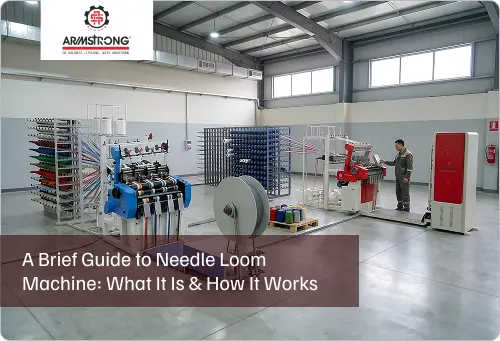
Cams want grease, dust builds up fast, and static can be a nuisance in dry weather. A fixed daily routine prevents most surprises. Needle looms need slightly different care; our guide to needle loom machine explains how they work.
Ask most plant owners, and they’ll sum it up as cost per metre.
Look at almost any woven sack, and there was a circular loom behind it:
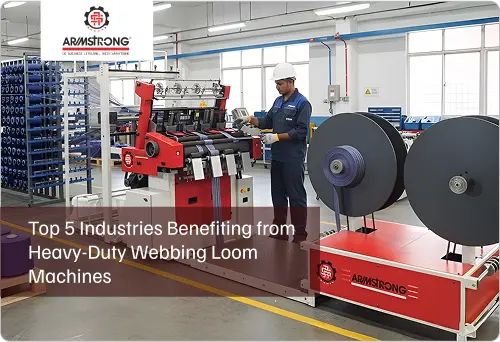
One thing people forget: the loom is only one stage. Plan it alongside cutting, printing, and stitching, or you’ll end up with a bottleneck somewhere else. FIBC units also weave plenty of belts and loops. Our piece on heavy-duty webbing loom machines looks at who relies on them.
A circular loom machine will sit on your floor for years, so don’t let the lowest quote make the decision.
Selection Checklist
| Factor | What to Check |
|---|---|
| Fabric width | Today’s widths and the ones you plan to add |
| Shuttle count | 4 for moderate output, 6 for more picks |
| Mesh and GSM | The weave density your buyers ask for |
| Real efficiency | Figures from running plants, not rated RPM |
| Tape range | A denier range that suits your extrusion line |
| Layout | Floor space and how rolls reach the next stage |
| Automation | Stop motions and electronic take-up on the circular weaving loom machine |
| Spares | How fast you can get shuttles, wheels, and reed parts |
| Growth | Whether the loom can adapt if specs change |
One tip: ask for a trial run on your own tape. Watching real fabric come off the loom for ten minutes tells you more than any brochure.
Armstrong has been building machines for PP and HDPE woven packaging for over 40 years, and you’ll find them running in more than 70 countries. Its circular loom machine line-up covers 4-shuttle, 6-shuttle, high-speed automatic, and jumbo bag fabric models. Since not every model suits every width or output, the team looks at your fabric first and then suggests a setup.
Every machine is assembled and tested in-house before it ships. Alongside the looms, Armstrong also supplies what a weaving floor needs day to day, including circular loom spare parts, ultrasonic loom cutters, bobbin cleaning machines and aluminium cheese tubes.
The range doesn’t stop at weaving. Armstrong makes cutting, printing and sewing machines too, plus needle looms for belts and loops, which do a different job from circular looms. That means you can plan your entire woven sack line, from fabric to finished bag, with a single supplier.

Your circular loom machine sets the pace for everything downstream. Top speed matters less than people think. What decides your output is the tape you feed it, the shuttle count, the take-up, and how well it’s looked after. Get clear on width, mesh, and daily target, then compare looms on real efficiency. Armstrong will be glad to help you work it out.
Explore more articles on innovation, engineering, and industry leadership.
December 7, 2024
September 8, 2025
October 15, 2025
November 25, 2025
November 26, 2025
December 29, 2025
January 27, 2026
February 23, 2026
February 24, 2026
August 10, 2026
August 20, 2026
August 26, 2026
September 16, 2026
September 19, 2026
 Previous